
Devices Overview
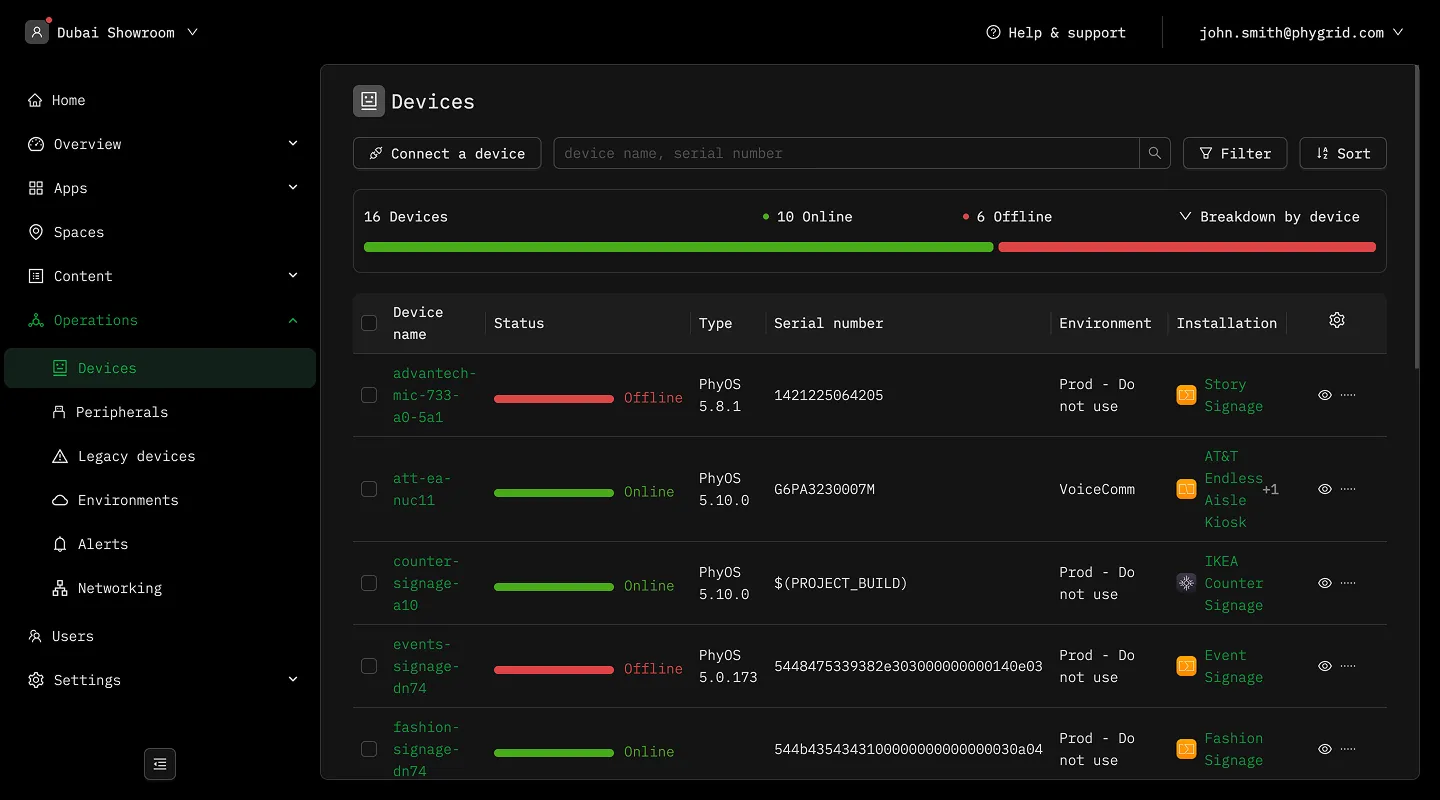
What are Devices?
Section titled “What are Devices?”Devices are physical hardware endpoints that run PhyOS and connect to the PhyStack platform. They execute Installations and serve as the delivery point for digital content and applications in physical spaces.
Why are Devices important?
Section titled “Why are Devices important?”Devices provide several key benefits for your platform deployment:
- Content Delivery: Automatically receive and run assigned Installations with seamless updates
- Remote Management: Configure, monitor, reboot, and update devices from the central console
- Space Integration: Belong to specific Spaces for organizational and content targeting purposes
- Operational Insights: Provide analytics, monitoring data, and status information for platform optimization
Device management features
Section titled “Device management features”Configuration & setup
Section titled “Configuration & setup”- Hardware Support: Compatible with Intel/AMD (x86-64), specialized devices, or virtual machines
- Space Assignment: Organize devices within your Space hierarchy for better management
- Custom Tags: Assign tags for flexible content targeting and device organization
- External ID: Add custom identifiers for integration with external systems
Operations & monitoring
Section titled “Operations & monitoring”- Remote Control: Reboot, configure, and update devices without physical access
- Device Monitoring: Track availability, operating hours, and performance metrics
- Status Overview: View real-time device status, connectivity, and installation information
- Analytics Integration: Access device-specific analytics and usage data
Supported hardware platforms
Section titled “Supported hardware platforms”- x86-64: PC based devices running Intel and AMD processors
- arm64: Giada DN74 media player
- Tizen: Samsung Tizen TVs running Tizen version 4, 6.5, 7, and 8. Tizen devices are only supported for signage applications.
- Edge AI devices: nVidia Jetson Nano Orin, Advantech MIC-711-ON-3A1, Advantech MIC-733-A05A1
VMWare and Hyper-V are the supported virtualization platforms.
You can also preview and test your applications in a browser, using web browser devices.
To successfully connect your device to the PhyStack platform and to run your application on it, the device needs to be properly configured and it needs to be online. Installing PhyOS is a requirement for x86-64, arm64 devices, as well as virtual machines.
Working with Devices
Section titled “Working with Devices”Device management
Section titled “Device management”Device operations
Section titled “Device operations”- Reboot a device
- Monitor a device
- Adjust device screen and audio settings
- Add tunnel links to a device